| Back to the Plastic Scale Modeling page |

|
|
Messerschmitt Me-109G the old 1/72 scale Airfix bag kit by Michael Morrow |
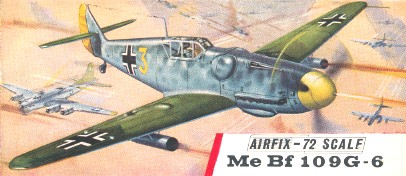 This fun little build was done for the July 2010 NWSM display at the Museum of Flight called "Strangers in a Strange Land", which displayed captured enemy aircraft in markings other than their own. In searching for a suitable candidate, I remembered an American Aviation Historical Society (AAHS) article about a couple of Me-109s captured in North Africa and painted in American markings, which would fit the bill perfectly. I rummaged about in my stack of reference materials, and there it was - in the Fall 1965, Vol. 10, No. 3 issue of the AAHS Journal, was an article entitled "Checkertails - History of the 325th Fighter Group Part I, August 1942 - May 1944", by Ernst R. McDowell. On page 162 of the Journal, the article included a short history, two photographs of captured Me-109s, and a description of how the Me-109G nick-named "Hoimann" was repainted in American markings. "Hoimann" was used by the Checkertails to familiarize new pilots with the flying characteristics of the Bf-109, and in one case, to take revenge for the poor performance of their escorts on a mission. The following is an excerpt from the article detailing the episode:
"The last straw came on a mission when the top cover that was to have been provided by the 14th Fighter Group, failed to materialize when needed most. Major Robert Baseler felt that these lads had spotted a Jerry and then the whole group had gone tearing off after him. Fortunately, no one was lost, but the Clan's P-40s had a few more bullet holes than would have been their normal quota had they been given the proper cover. Getting back to base, Major Baseler had the ground crew roll out "Hoimann," the liberated Me 109G that had been obtained when North Africa fell. "Hoimann" was painted a matte black all over with a red spinner, rudder, and ailerons with standard American markings. Taking off, he made a bee line for the P-38 field, where he understood the 14th Fighter Group was stationed at the bottom of the hill. Down over the hill he roared and went barreling across the field with its P-38s at 100 feet, pulled up and roared back in another pass. As it happened, he had selected their dinner hour and the entire personnel was in a long G.I. chow line. When the plane pulled up to roar back and the G.I.s recognized it as a Messerschmitt, the sky filled with flying Spam, mess kits, eating utensils, etc., as men scattered in all directions heading for the nearest cover. Major Baseler, recalling the scene, said it was "like a bunch of chickens after they see the shadow of a chicken hawk on the ground." Major Baseler calmly flew back to base and landed."The Me-109G nick-named "Hoimann" would be perfect for the coming NWSM display. 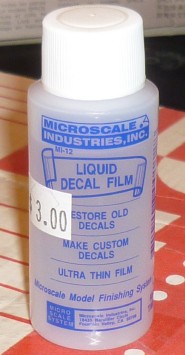 All I needed was a 1/72 scale Me-109G kit for the project. I'd been down to Emil's Skyway Hobby to get some paint, and I remembered some old Airfix 109 bag kits. On the next trip of opportunity (never make sole-purpose trips!), I picked up one of those old Airfix Me-109G bag kits for a VERY reasonable price.
Careful examination of the photograph of one of the all-matt-black Me-109s in the AAHS article gave an idea of some of the markings on the aircraft, and perusal of photos off the internet verified other markings. A rational for the markings I used on my interpretation of "Hoimann" is given further down in this post. Going through my decal box produced a set of standard American markings from an old Revell kit that were exactly the right size. They were old, but I had some Microscale Industries Liquid Decal Film (decal restorer) (see picture), so I was all set. Liquid Decal Film (decal restorer) ------------>As is always the case, the best laid plans don't always come to pass. An out-of-town trip conspired to limit my building time, but on a kit this simple, it ended up not mattering much. It was a very straight-forward build. I did add a couple of simple little details to make it fun . . . |
|
Scale supports for the front of the oil filter made from stretched sprue were also added, and the rear of the oil filter was slightly reshaped. The narrow metal strip visible on the side of the screen running from the aft intake section to the front cap was made from thin paper and glued to the screen. In retrospect, I could have used shim brass for a slightly neater look, but it looks okay as is. These simple improvements added greatly to the realism of the finished model. |
|
|
|
With the exception of a few minor changes and fixes, I left the rest of the kit as stock as possible in order to meet the building deadline. Those minor changes and fixes included the following:
|
|
The all-black shelves of the NWSM display cases presented a unique problem for this all-black model, which I solved by making a light-colored base. Since the real aircraft was flown off a desert field, the base achieved a double purpose - it represented the actual surface the aircraft flew from, and it provided a contrasting color under the all-black 109 to differentiate it from the all-black display case shelves. A five and a half by six inch piece of 1/8 inch thick fiberboard was used for the base. I had already planned on having wheel tracks leading to the 109's final position on the base. The tracks would curve, and the tail wheel track would show that the pilot had swung the 109 into it's final position. This required an exercise in graphical analysis to plot the wheel tracks, which were then transferred to a piece of paper, and the tracks cut out, leaving a mask in the shape of the eventual tracks.  To make the actual tracks, I made a simple wheeled bar with the wheels set the same distance apart as the 109's. The base was coated with thinned Elmer's glue, over which baking flour was liberally sprinked and pressed down. The wheel track pattern was placed over the base, and the wheel track device was rolled along the tire tracks cut into the paper wheel track pattern creating indentations in the "sand" to simulate the main wheel tire tracks in the not-yet-dry flour and glue mixture. The tail wheel track was added, and the base was set aside to dry. When the base was dry, it was sprayed with a light flat tan to represent the dirt/sand that the aircraft had to operate off of, and the base was finished.
 |
|
The Markings The markings I used were as listed in the Fall 1965 issue of the AAHS Journal on page 162, starting on line 8: " "Hoimann" was painted a matte black all over with a red spinner, rudder, and ailerons with standard American markings."Having seen pictures of a multitude of "Hoimann" models on the internet, I was a bit puzzled, as many of them also show the 109's wing flaps and stabilizer elevators painted red (not mentioned in the reference). Most of them show a color scheme that looks like this: 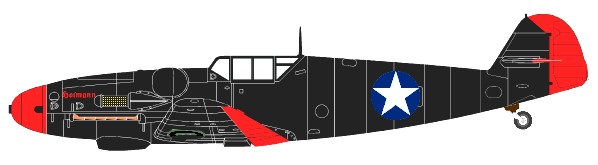 An extensive search turned up no photos that could verify this interpretation, so I only painted those items red that were specifically listed as red, namely the spinner, ailerons, and rudder. Many of the models and most of the color profiles on the 'net also showed the aircraft nickname "Hoimann" painted red, the wrong size, and or the wrong location (also shown in the color profile above). Here there is specific evidence that contradicts that interpretation, namely a photograph, and here is that photograph: 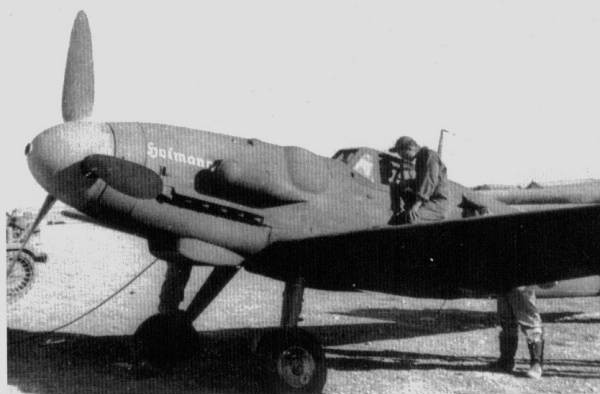 I'll deal with the color of the nickname "Hoimann" first. There were two types of black and white film commonly used in WWII - orthochromatic, and panchronatic. Orthochromatic reproduced red as black, and panchromatic reproduced red as a shade of gray. In this photo, we know the fuselage is matt black and the propeller spinner is red, and the photo clearly shows the difference in color between the two. Since we can see that the two colors are different, we know the film is panchromatic, which would mean that red would print as a shade of gray, which the spinner indeed does. The nickname "Hoimann" does not. It shows as white, so that is the color I used for the nickname "Hoimann". Now for the size and placement. Replicating the nickname would not be easy. First I had to find a typeface that matched that shown in the photograph. Coreldraw has more typefaces than you can shake a stick at, and after going through the list several times, I chose Frankenstein as the closest starting point, and modified each individual letter to match the ones in the photo. The letters done, I matched the spacing, and then scaled it to size. In the photo, the left-most part of the 'h' touches a major panel seam, and on the right, the upper tropical filter support strut terminates in the middle of the last 'n'. In 1/72 scale, the length worked out to 0.36 inches from the left-most side of the 'h' to the right-most serif on the last 'n', and the height worked out to about 0.083 inches from the bottom to the top of the 'h'. Here's the pattern I worked out in CorelDraw before reducing it to 1/72 scale . . . 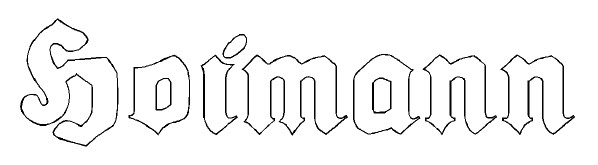 Not having an ALPS printer to print white decals, or access to someone who does, I endeavered to airbrush it using a stencil cut laboriously by hand. The results . . . well, just remember that as finshed on this 1/72 scale model, the name "Hoimann" is only about 1/3 of an inch long, most of the letters are just over 1/32 of an inch tall, and even the tallest letter, the 'h', is still less than 3/32 of an inch tall. The camera can see imperfections the naked eye can't, so it actually looks much better in person. Even so, if you've got access to somebody with an ALPS printer, by all means, have them print a little decal up for you, which you should put on before you add the tropical filter to the side of the fuselage. The national insignia was a much more interesting problem, as there is no photo of "Hoimann" painted black where the national insignia can be seen in any position, but we do know that "Hoimann" was painted with ". . . standard American markings." In the only photo of "Hoimann" painted black (that I could find), the bottom of the left wing is too dark to see the insignia, and one of the 325th's personnel is standing in the exact spot and posture necessary to completely obscure the entire part of the fuselage where the insignia might have been visible (situations like this are why, when I'm shooting photographs of aircraft, I'll wait for very long periods of time to get every last person out of a picture before taking it, or at the very least, hide them behind a landing gear leg). As mentioned above, All of the interpretations of "Hoimann" that I've seen show the standard 1942 to June 29th 1943 American markings of a white star on a blue surround. No controversy there, right? Weeellllll . . . . 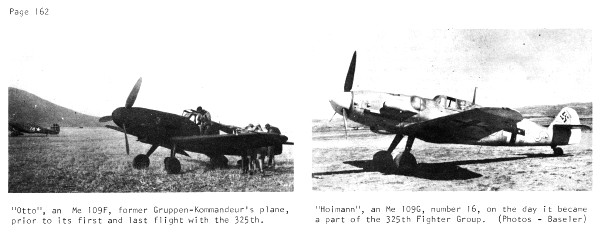 What's this? An all-black Me-109 being attended to by 325th personnel? Why, yes, it is! Sadly "Hoimann", it's not. The photo is from the top of the page of the previously referenced AAHS article, and per the caption, that's "Otto", a Bf-109F, just before it's first and last flight with the 325th. Here's a close-up: 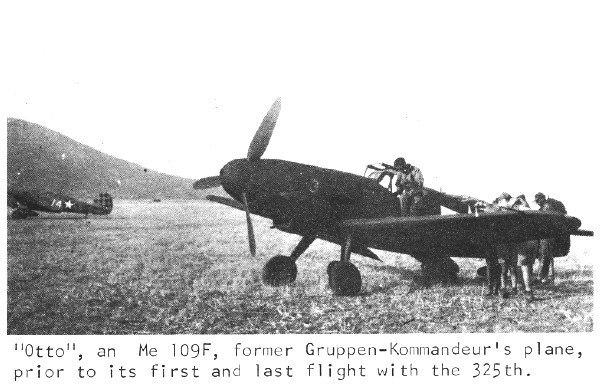 In the background on the left, you can just make out one of the checker-tail clan's P-40's with it's white star on blue circle insignia and checkerboard tail. Here's a closer crop of "Otto" . . . 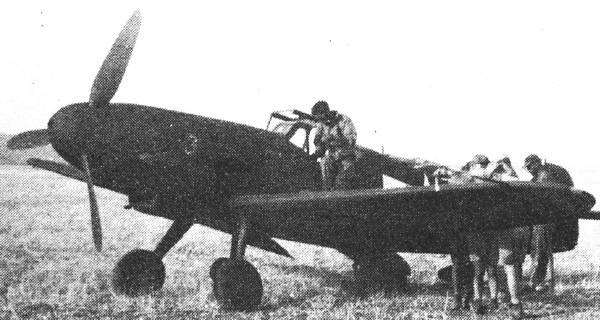 Sadly, the original reproduction of the photo in the AAHS article was too dark and too small to show any color details, other than a vague hint that the spinner might be a different color. Far more interesting however, is something just barely visible on the aft fuselage, and that's the top edge and left corner of the ". . . standard American markings". The "star-and-bar" standard American markings. This is interesting because even in the poor quality previous uncropped photo, you can see that the P-40 in the background still has the older style insignia of white star in a blue circle with no white bar, while just barely visibly above "Otto"'s aft fuselage is another aircraft that distinctly does have the "star-and-bar" insignia. Sadly, it's too small and indistinct to tell what type aircraft it is. It's possible it could be the 109G "Hoimann", although it's not likely - it appears to be not black, but a lighter color, and also looks to have a checkertail, although most of the tail is hidden by people. There's no doubt about "Otto" though - it definitely has star-and-bar" American insignia. Here's a close-up: 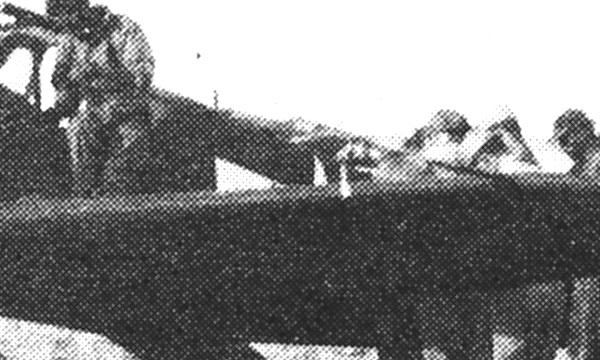 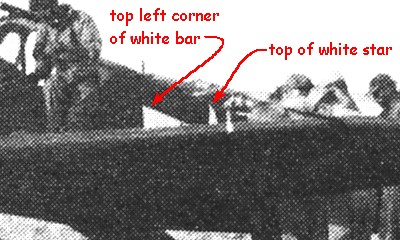 If you're not quite sure what you're looking at (and that's pretty easy due to the poor photo quality reproduction), I've pointed out the important bits here . . .
So . . . we know that "Otto" had star-and-bar insignia when there were still checkertails that had the old style insignia. What implications does that have for "Hoimann"? Obviously, the ". . . standard American markings" changed between the time the P-40's were painted, and the time "Otto" was painted, and maybe even before "Hoimann" was painted. Knowing a timeline could help, even if it is all supposition with no photographic proof. We know when the 325th acquired "Hoimann" (yellow '16') from the AAHS article: "The Me 109G they had named "Hoimann" in honor of Hermann Goering had been found in a wheat field two days after the surrender."We know the date of surrender. From the same AAHS article, page 157, column two, paragraph 3: On 13 May 1943 General Von Arnim surrendered the last Nazi forces in North Africa to bring that phase of the war to an end."So on May 15th, the Bf-109G that would become "Hoimann" was found in a wheat field. On June 29th, 1943 (June 28th, according to Peter M. Bowers), the standard American markings changed from a white star in a blue circle, to a white star in a blue circle with white side bars, all outlined in red. The red outline was changed to blue September 17, 1943, 80 days later (a little over two and a half months). Peter Bowers gives the date of September 5th for the change from red outline to blue outline. If the September 5th date is used, the 80 days drops to just 68 days (two months and 6 days). the progression of standard American markings is shown below.  Judging by the uncropped AAHS photo of "Otto", which showed at least two different versions of the "... standard American markings", the later star-and-bar type on both "Otto" and the aircraft just visible above the back of "Otto's" fuselage, and the earlier type on the P-40 in the background on the left, it appears that aircraft were painted in the scheme required when they needed painting. Because "Otto", the 109F, has the newer star-and-bar insignia, we can presume it was painted after either September 5th, or after September 17th, whichever the real marking change date was, but obviously during a time of markings transition, as shown by the two aircraft in the background. It is of course possble that the older-marking adorned aircraft in the background on the left was a non-flying junker that didn't need new markings, and all other aircraft had already had their insignia re-painted, in which case, "Hoimann" would also have the newer markings. All that remains is to determine when "Hoimann" was painted. Sadly, unless an enterprising 325th serviceman's personal journal is found where he just happens to mention the exact date this occurred, we'll never know. But I'm going to make a guess anyway, and since you already know I chose the later star-and-bar insignia just by looking at the first photo at the top of this post, here's my reasoning: The aircraft may have been found on May 15th, but it wasn't flight-worthy. Time would have been required to put it right, and by the time "Hoimann" was repaired, the new American markings standard may have already been in effect. In the AAHS article is this description of the aircraft's condition when it was found: "As there was a British airbase nearby, Maj. Baseler checked with them, since he felt they might have a prior claim to it, but they told him that they had taken what they wanted, namely the radio and battery, and the Clan had a 109 to test fly. It had been landed by the mortally wounded pilot, relatively intact. A single 20mm shell had gone through the upper longeron on the left side of the fuselage and exploded in the cockpit. Another had penetrated the left side of the fuselage and exploded against the laminated aluminum armor-plating behind the pilot, while a third one had pierced the fabric on the rudder. One tire had gone flat, apparently due to a hard landing. This was the extent of the damage. A new battery was put in along with a new radio and the damage was patched up. Later on, the Group obtained a 109F, "Otto", in which Maj. Baseler experienced a narrow squeak while giving the plane it's first flight. A number 6 rod on the right bank of cylinders broke and went through the crankcase and sheered off an oil line and the coolant line as well. It then caught fire and he had to belly it in but escaped injury, although "Otto" was written off so far as further flying was concerned."So the future "Hoimann" had to be fixed a bit. Sounds fairly straight-forward from the descripton above, but probably not as simple as it was made out to be, I suspect because compared to some of the repair work they'd had to do to keep damaged P-40s combat-ready, it was a relatively easy task. Note that I said arelatively easy task. That's not the same thing as an easy task. Here's what needed to happen:
 More importantly, there's no date on the photograph of "Hoimann", so it could have been taken at any time, during any of the official markings periods, from the time the 325th finished repairing it (whenever that was), right through the time period after September 5th/17th, when the insignia changed to star-and-bar with a blue outline. Since the "Hoimann" photo doesn't show any insignia at all, and barring another photo turning up which does show the insignia, it actually doesn't matter which insignia is used. Theoretically it could have had all three versions of the standard American markings painted on it at one time or another, and since it may have been re-painted after each change in markings standards, it likely did end up with the blue outline insignia. With the above in mind, I chose to use "star-and-bar" insignia with a blue outline on my Bf-109G-6 "Hoimann". That's my story, and I'm sticking to it. So here's the color scheme I elected to use: Black overall, with red spinner, ailerons, and rudder, the "Hoimann" nickname in white, white star-and-bar insignia with a blue outline, and gray-green wheel hubs, all as shown in the color profile below. 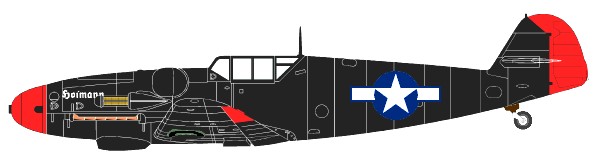 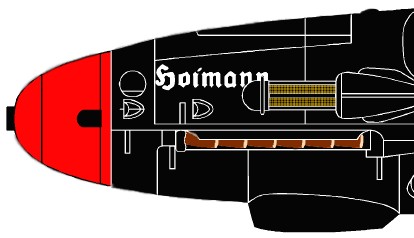 The correct placement of the nickname "hoimann" - the left-most part of the 'h' touching the panel seam, and on the right, the upper tropical filter support strut terminates in the top of the slot in the last 'n'.
 |
. . . some more photos of my Bf-109 G-6 "Hoimann" build.
|
